

What is cold processed soap?
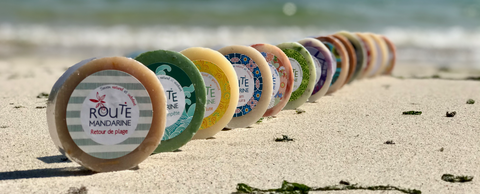
Route Mandarine was the first soap factory in Finistère. Since 2011, the Route Mandarine soap factory has been offering natural and distinctive cold-process soaps. Its ambition is to offer solid cosmetics made in Brittany that are as pleasant as liquid cosmetics, so that everyone enjoys switching to solid cosmetics. Products that are:
- gentle,
- comfortable,
- easy to use,
- healthy,
- colorful and fragrant for maximum pleasure.
What does "cold-process soap" mean?
What we call cold-process soap is soap that has not been cooked. All steps in the making of cold-process soap are done at room temperature. Marseille soap or Aleppo soap, for example, are "hot-process" soaps, whose paste has been cooked for several hours.
Why did we choose the cold saponification method?
We chose the cold saponification method because it allows us not to heat the ingredients; thus we preserve the full quality of the ingredients we have selected. Moreover, the cold saponification method greatly limits the energy consumption required for soap manufacturing, which drastically reduces the carbon footprint of our products. Since 2023, we have been working on the carbon footprint of our workshop to limit our impact on global warming. Little by little, we are looking for solutions to limit our greenhouse gas emissions.
How is cold-process soap made?
The principle of cold saponification is simple:
Fat + base = soap + glycerin.
All fats are saponifiable, whether they are of animal or vegetable origin. At Route Mandarine, we have chosen to work only with vegetable oils because they produce a gentler soap for the skin, less detergent than a cold-process soap made from beef fat, for example.
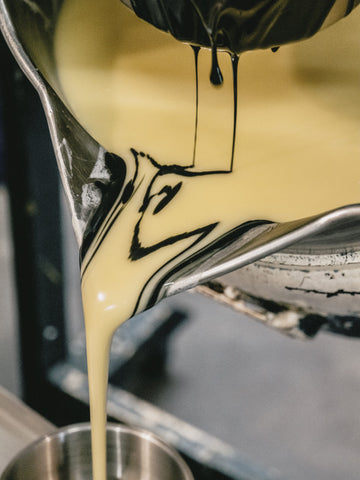
@Simon Cohen
The base used to transform the oil depends on the soap you wish to obtain. If you want a soft soap, like Moroccan black soap, then use potash to transform your oils. In our case, we want a solid soap that lasts a long time, which is why we use soda to transform the oils we have chosen.
The glycerin produced naturally during cold-process soap making will deposit on your skin with each shower to protect it from dehydration. Shower after shower, your skin no longer feels tight; it is protected by this natural glycerin.
What oils do we use in our soaps?
We have chosen to use only certified organic vegetable oils to make our soaps. Each oil will impart different properties to the soap once saponified. Here are the oils we have chosen:
- olive oil, because it is the one that produces the mildest soap for human skin. But a 100% olive oil soap would not lather and would melt very quickly.
- to get abundant lather during use, we chose coconut oil; saponified coconut oil lathers so much that it would even lather in seawater.
- to soften the overly cleansing effect of saponified coconut oil, we chose shea butter which will create a creamy lather with a lot of care.
- And for the soap to last a long time and not disintegrate in the shower, we use RSPO certified palm oil .
Thus we have a soft soap that lathers well and lasts a long time in the bathroom. For even more care, we add 5 to 7% superfat.
What is superfat in soap?
Superfat is an oil that will not be transformed into soap and can thus be found in the final product. At Route Mandarine, all our soaps have 5% superfat and mon ange soap has 7% superfat.
We have chosen noble oils as superfat which will add care to the soap. For example, in the soap "Envie d'ailleurs", the superfat is very nourishing avocado oil, ideal for dry skin. Whereas in the soap "Sous le soleil exactement", the superfat is hazelnut oil, which is a light oil, ideal for facial care.
Colored and Fragrant Soaps
When Tiphaine created the soap factory in 2011, many (many) of us were using shower gels found in supermarkets. To convince as many people as possible to switch to solid cosmetics, Tiphaine thought it was absolutely essential to be able to find the diversity of fragrances and colors offered by shower gels of the time, but with one requirement: to use only natural ingredients.
And nature abounds in magnificent colors such as ochres, clays or oxides. Combined with seeds or flowers for texture, this offers an infinite palette to satisfy all desires.
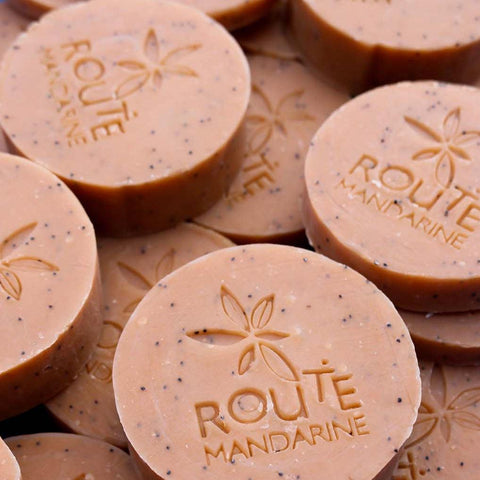
For fragrances, Tiphaine drew from the immense diversity of essential oils to create the scent of each soap. Each of the 15 soaps in our range is inspired by a journey taken or dreamed of, taking you to the four corners of the world: Japan, Ouessant Island, Africa, etc.
Cover photo @Simon Cohen

1 comment
Bonjour et merci de nous partager cet article très instructif.
Facultad de Ciencias Económicas